Running a small business comes with resource constraints. Fortunately, accessible AI tools now allow small teams to operate with the efficiency of large enterprises.
From creating marketing materials and writing customer emails to analyzing data and automating repetitive tasks, AI can help business owners save time, reduce costs, and focus on growth.
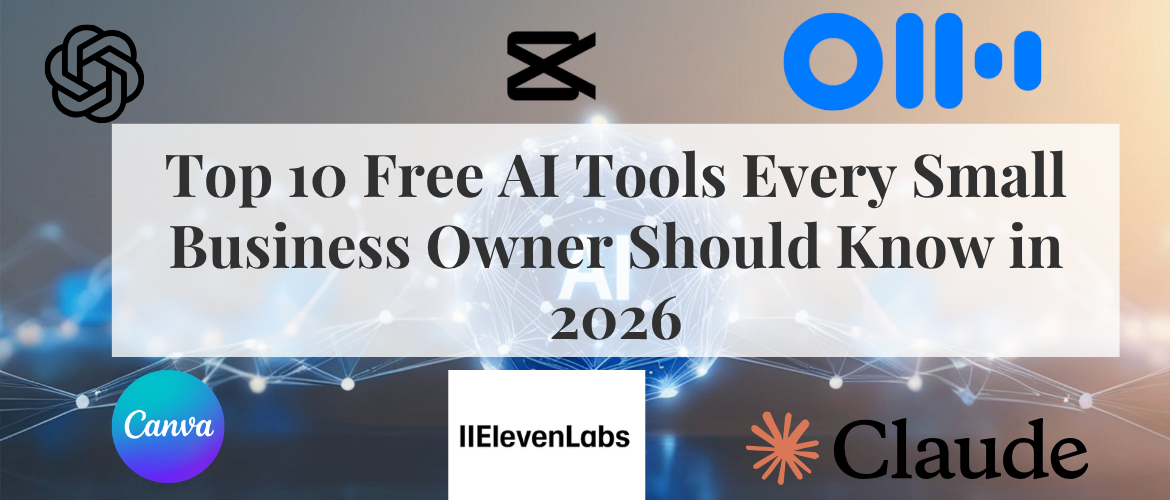
Here are 10 free AI tools every small business owner should know in 2026.
1. Visual & Graphic Design
Tools like Canva Magic Media and Leonardo.ai enable non-designers to produce promotional graphics, social banners, product mockups, and other visual content quickly.
Instead of hiring a designer for every social media post or marketing campaign, small businesses can use AI-powered design tools to create professional-looking visuals in minutes.
Best for: Social media graphics, advertisements, presentations, product images, and marketing materials.
2. Writing & Customer Outreach
ChatGPT and Claude excel at writing email responses, product descriptions, promotional announcements, social media captions, blog posts, and other business content.
You can also use them to brainstorm marketing ideas, rewrite complicated messages, create customer support responses, and turn rough ideas into polished content.
Best for: Content creation, email marketing, customer communication, product descriptions, and brainstorming.
3. Voice & Audio Automation
ElevenLabs provides realistic AI voice generation that can be useful for marketing videos, product demonstrations, social media content, and educational materials without expensive recording equipment.
A business owner can turn a written script into a professional-sounding voiceover and use it in videos or presentations.
Best for: Voiceovers, marketing videos, tutorials, podcasts, and promotional content.
4. Video Creation & Editing
Creating video content no longer requires expensive cameras or advanced editing skills.
Tools such as CapCut offer AI-powered features that can help small businesses edit videos, generate captions, remove backgrounds, add effects, and create short-form content for platforms such as TikTok, Instagram, YouTube, and Facebook.
AI video tools can significantly reduce the time required to turn raw footage into publishable content.
Best for: Social media videos, product demonstrations, tutorials, advertisements, and short-form content.
5. Meeting Notes & Transcription
Small business owners spend a significant amount of time in meetings, consultations, and calls.
AI transcription tools such as Otter.ai can record conversations, convert speech into text, and help organize important information from meetings.
Instead of manually taking notes, you can focus on the conversation while AI helps capture the key details.
Best for: Meeting notes, interviews, consultations, team meetings, and customer calls.
6. Research & Information Gathering
Research is another area where AI can save business owners hours of work.
Perplexity combines AI with web search to help users research topics, compare information, and quickly find answers with supporting sources.
For example, a business owner researching competitors, industry trends, customer problems, or potential markets can use AI to organize information much faster than starting with dozens of individual searches.
Best for: Market research, competitor research, industry trends, and general business research.
7. Productivity & Task Management
AI can also help business owners organize their daily operations.
Notion AI can help turn notes into structured documents, summarize information, generate ideas, and organize business knowledge.
Instead of keeping scattered notes across different applications, you can create a central workspace for projects, processes, meeting notes, and company information.
Best for: Project management, documentation, planning, meeting notes, and business organization.
8. Data Analysis
You don't need to be a data scientist to start getting useful insights from your business data.
AI assistants such as ChatGPT can help analyze spreadsheets, identify patterns, summarize sales information, and explain data in simpler language.
For example, you could upload a sales spreadsheet and ask AI to identify your best-performing products, unusual changes in revenue, or trends that deserve attention.
Best for: Sales analysis, financial reports, customer data, spreadsheets, and business insights.
9. AI-Powered Customer Support
Customer support can become difficult when a small team starts receiving more inquiries.
AI chatbot platforms can help businesses answer frequently asked questions, provide basic information, and assist customers outside normal business hours.
For businesses with websites, an AI chatbot can handle repetitive questions while human employees focus on more complicated customer issues.
Best for: FAQs, lead generation, customer support, website chat, and basic inquiries.
10. AI-Powered Automation
One of the biggest advantages of AI is its ability to reduce repetitive work.
Tools such as Zapier can connect different applications and automate repetitive workflows. For example, a new lead submitted through a website could automatically be added to a spreadsheet or CRM, while an email notification is sent to the sales team.
These small automations can save hours every week.
Best for: Lead management, email automation, CRM workflows, notifications, and repetitive administrative tasks.
How Small Businesses Can Start Using AI
You don't need to adopt all 10 tools at once.
Start with the area of your business that consumes the most time. If creating content is your biggest challenge, begin with an AI writing or design tool. If administrative work is slowing you down, look at automation and productivity tools.
The goal isn't to use AI simply because it is popular. The goal is to use it to solve real business problems.
A good starting point is to identify three repetitive tasks you perform every week and ask:
“Can AI help me do this faster, cheaper, or better?”
If the answer is yes, that's where you should start.
Final Thoughts
AI is no longer limited to large corporations with massive technology budgets. In 2026, small businesses can access powerful AI tools that help with marketing, customer service, content creation, research, productivity, and automation.
The businesses that benefit most won't necessarily be the ones using the most AI tools. They'll be the ones that learn how to integrate the right tools into their everyday workflows.
Start small, experiment with free plans, and focus on tools that directly save you time or help you generate more revenue.


Written by Rasheed Muraina
Lead Strategist & Educator at AI Hustle Blueprint.